
Cognitive intelligence with a creativity edge
IQCognitive Intelligence
How the mind reasons, remembers, and generates something meaningfully new -- not just a test score, but a dynamic system that optimizes within constraints and, at its highest, redefines them.
Daily intelligence briefing
Latest content from voices in this domain.
Listen
A short audio introduction.

Core concept
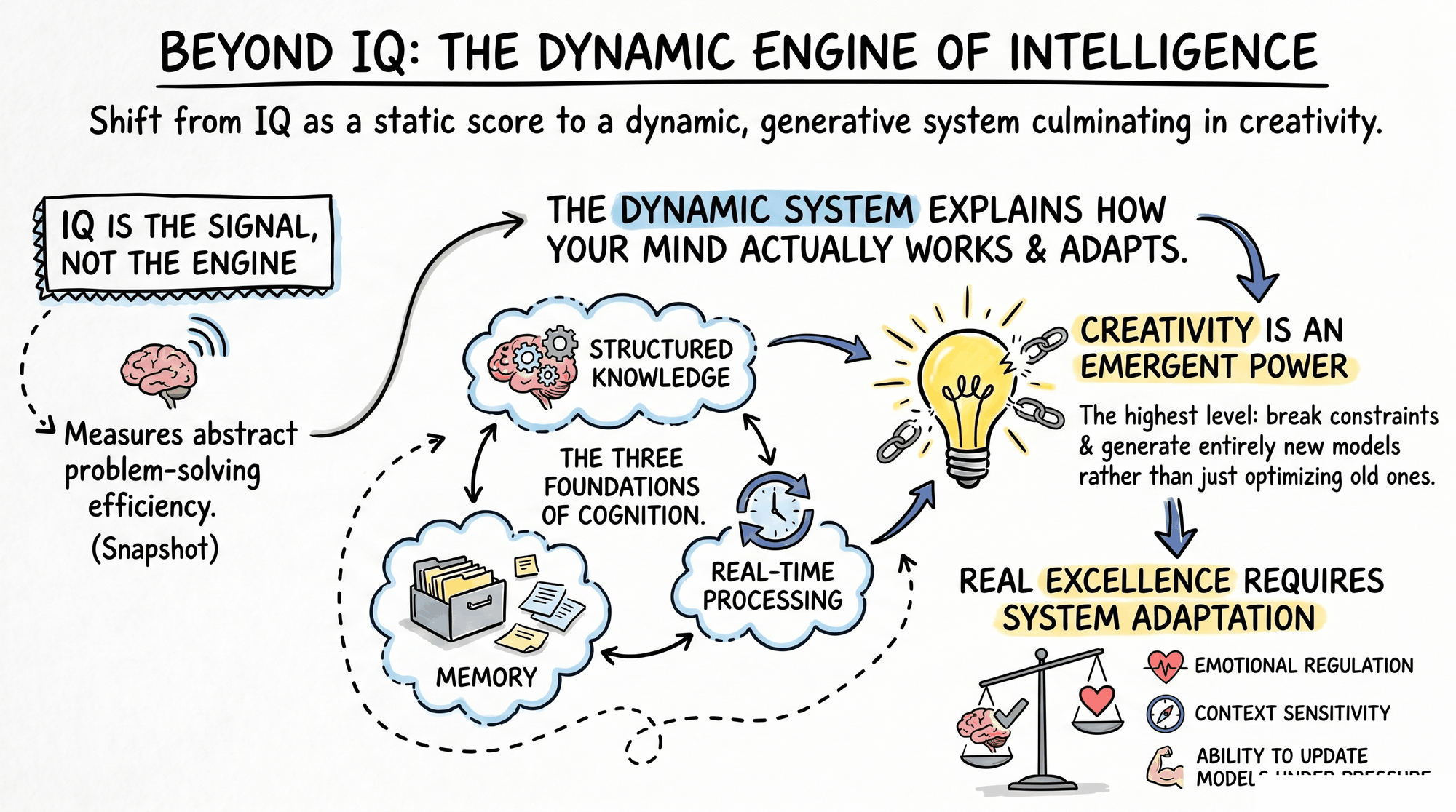
IQ is a standardized, statistical proxy for the efficiency of a deeper cognitive system whose true nature is dynamic, integrative, and context-dependent. It measures how well the system performs on abstract problems; the whole-person model explains how the system actually works.
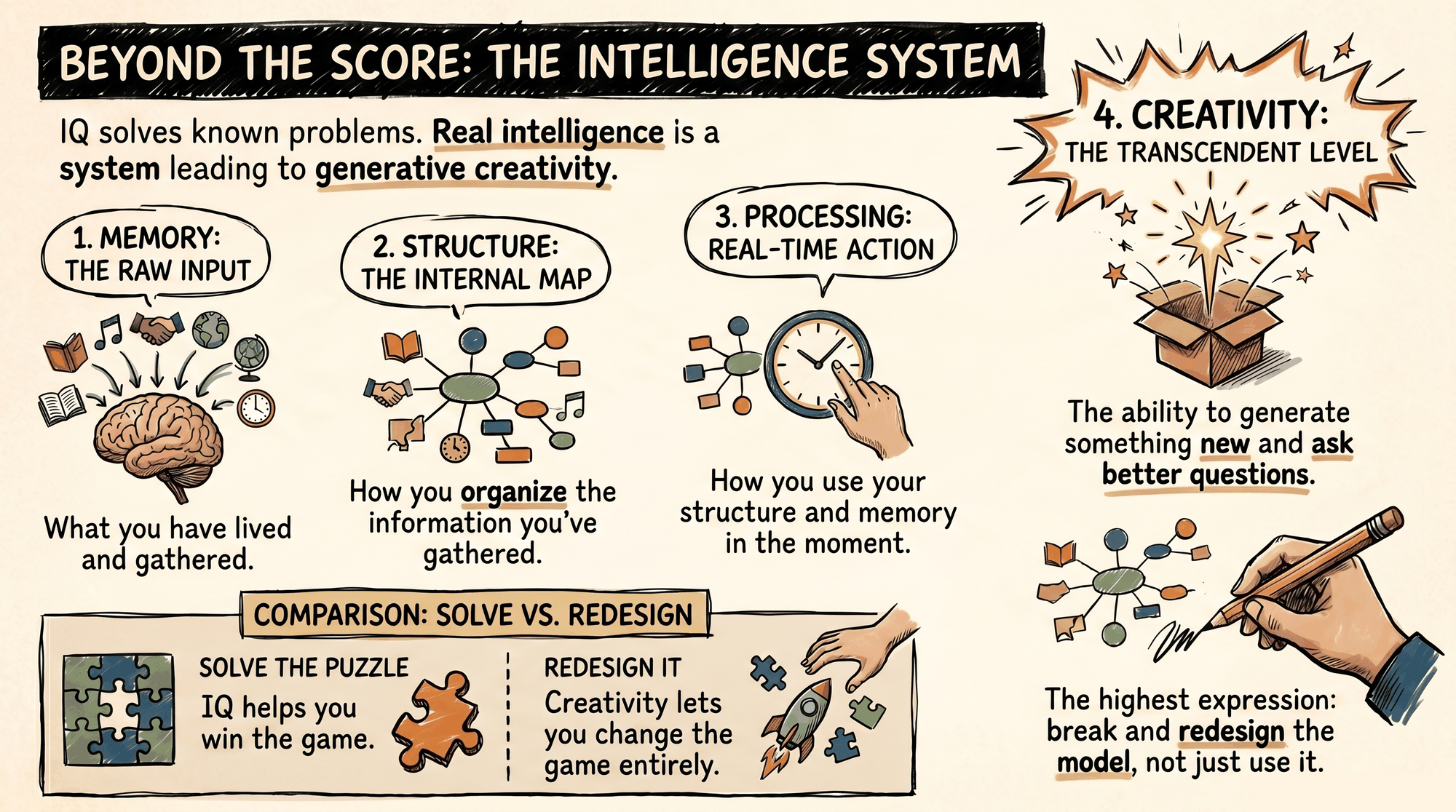
The model has three foundational substrates and one emergent capability. The substrates are stored memory, structured knowledge, and real-time cognitive processing. The emergent capability, sitting on top of all three, is creativity -- what happens when the system becomes generative rather than merely adaptive.
Standard IQ focuses on recognizing patterns, manipulating symbols, and solving defined problems. Creativity adds novel pattern formation, model generation (not just selection), and externalization -- putting the new thing into words, images, or designs the world can see. Where IQ optimizes within constraints, creativity redefines the constraints.
A sharper definition: creativity is the system's capacity to generate, externalize, and refine novel representations that are not strictly determined by prior models, even while drawing upon them. It includes yet transcends cognitive processing alone.
The practical upshot: high-IQ individuals can still perform poorly when their system cannot adapt in real conditions. Real-world excellence depends on model-updating speed, emotional regulation under load, context sensitivity, and learning loops over time -- and at the highest level, on the creativity that lets the system invent something it has never done before.
Featured voices
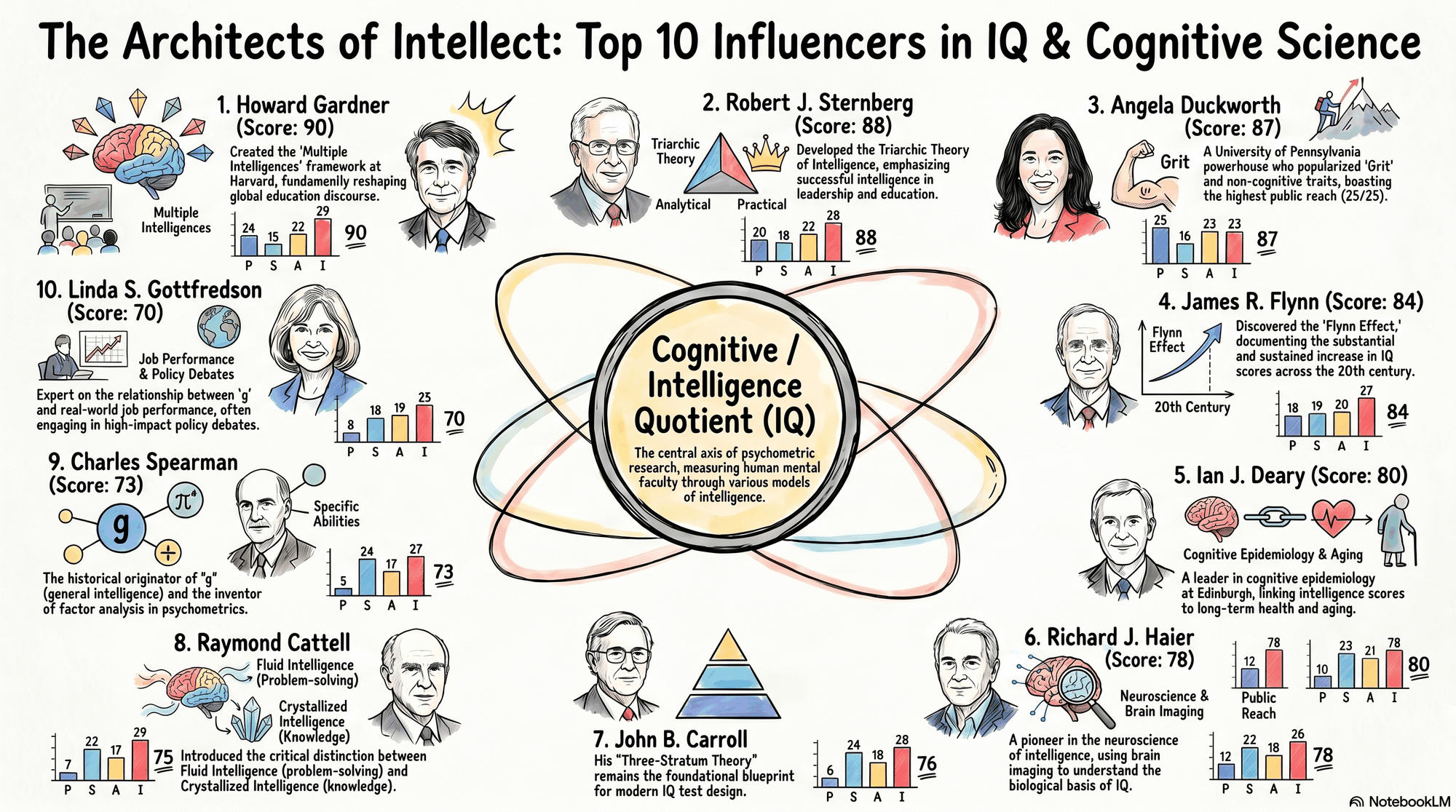
Proof sources backing this intelligence -- a visual rollup of the public thinkers, researchers, and practitioners whose work underwrites the framework.
Graphics
Top thought leaders of Cognitive Intelligence
Podcasts, articles, social reach, books and research papers with direct links to the 'top thought leader websites' for your easy reference. Or scroll down on this site to view some of the very best videos as 'Featured Talks'. All of this content is curated and kept current.
| # | Name | Domain | Score | Primary contribution | Website |
|---|---|---|---|---|---|
| Howard Gardner | Developmental Psychology / Education | 90 | Multiple intelligences (linguistic, logical-mathematical, spatial, etc.) | link | |
| Angela Duckworth | Personality / Educational Psychology | 88 | Grit, self-control, and non-cognitive traits interacting with cognitive ability | link | |
| Robert J. Sternberg | Cognitive / Educational Psychology | 82 | Triarchic theory: analytical, creative, practical intelligence; successful intelligence | link | |
| James R. Flynn | Moral and Political Philosophy / Intelligence Research | 80 | Flynn Effect: secular rise in IQ scores over generations | link | |
| Ian J. Deary | Differential Psychology / Lifespan Epidemiology | 78 | Lifespan stability of intelligence and links to health and aging | link | |
| Richard J. Haier | Cognitive Neuroscience / Intelligence | 75 | Neurobiology of intelligence, brain efficiency, and structural correlates of IQ | link | |
| Raymond Cattell | Psychometrics / Personality | 72 | Fluid vs. crystallized intelligence distinction | link | |
| Charles Spearman | Psychometrics / Experimental Psychology | 70 | General intelligence factor (g) underlying performance across cognitive tasks | link | |
| Arthur R. Jensen | Educational Psychology / Psychometrics | 70 | Heritability of IQ, reaction time, and group differences in intelligence | link | |
| John B. Carroll | Psychometrics / Differential Psychology | 68 | Three-stratum theory integrating g, broad abilities, and specific skills | link | |
| Linda S. Gottfredson | Differential Psychology / Occupational Psychology | 65 | General intelligence as a central predictor of job performance and life outcomes | link |
Featured talks
One signature talk or interview per leader -- click a thumbnail to play. Nothing streams until you click.
Community chat Under development
A small, moderated space for practitioners and learners to compare notes, share practices, and ask questions in this intelligence domain. We are building this now. If you want to be notified when it opens, leave your details on the chat-community signup.
Join the chat community